
By Shivam Das | October 12, 2026
Jack Huston’s Aaron Graham is one of the most notable additions to the 2026 television adaptation of Treasure Island. Paramount+ promotional material describes Graham as a revolutionary spy. But readers of Robert Louis Stevenson’s original novel will not recognize him as a book character. Does this new figure deepen Jim Hawkins’s journey, or pull the story away from the treasure hunt that gives it its name?

Quick answer: Is Aaron Graham an unnecessary character?
Not automatically—but the character has to earn his screen time. Graham gives the series another adult influence competing to shape Jim’s choices, potentially adding moral complexity to a coming-of-age adventure. The risk is structural: if his political storyline repeatedly pauses the hunt for Captain Flint’s treasure, viewers may feel a different drama is interrupting Treasure Island.
Who is Aaron Graham?
Huston plays Aaron Graham, a merchant with secrets and a revolutionary-spy dimension created for this adaptation. The official series introduction lists Graham among the principal characters. The six-part series reimagines Stevenson’s 1883 novel, with Tom Sweet as Jim Hawkins, Hayley Atwell as Bess Hawkins and David Oyelowo as Long John Silver. Graham is an adaptation-specific character, not a forgotten figure from the book. His role should be judged on what the television story gains from him—not on whether he reproduces a scene from Stevenson word for word.

Why add a revolutionary spy to a pirate adventure?
The strongest argument for Graham is that an adaptation needs more than familiar landmarks: an inn, a map, a ship and a dangerous crew. A character connected to political intrigue can widen the world beyond the treasure itself. He may also give Jim a contrasting model of authority, placing strategy and persuasion alongside Silver’s charisma and Bess’s determination. If Graham offers help while concealing his real priorities, Jim must learn that apparent protection can carry a price. In that version of the story, Graham becomes part of the test that forces Jim to judge people for himself.
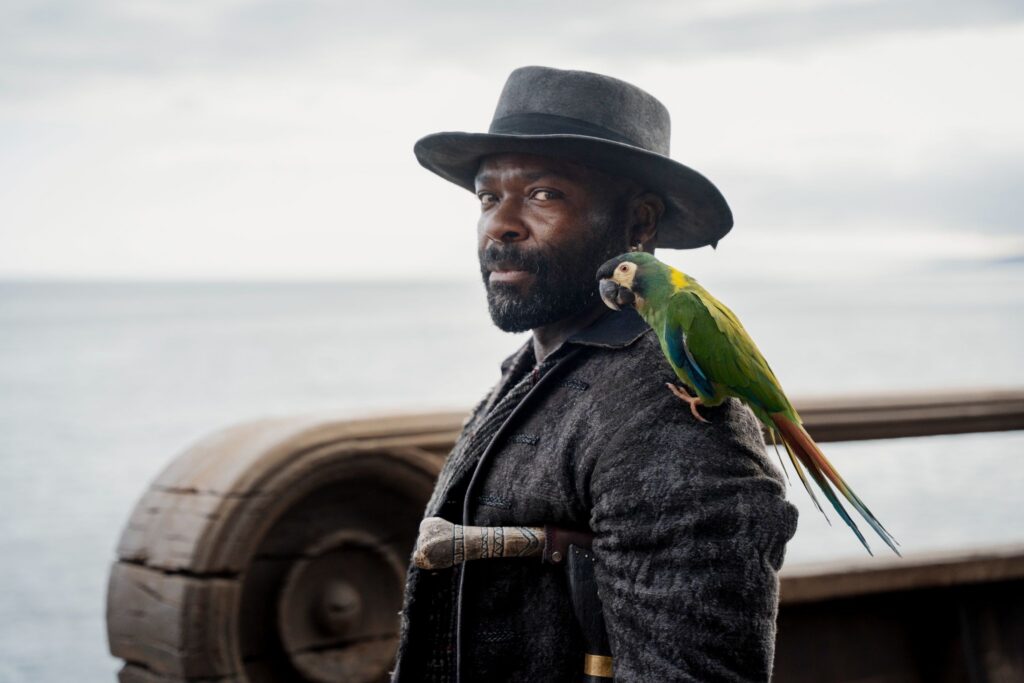
Where the character risks taking the story off course
The danger is not simply that Graham was invented. Adaptations routinely add, combine or reshape characters. The real test is whether his scenes increase the pressure on Jim and advance the central conflict—or ask viewers to invest in a separate political thriller while the promised treasure hunt waits in the background.
In its October 12 review, The A.V. Club questioned the purpose of Graham’s storyline, arguing that an extended detour away from the treasure makes it harder to care about the character’s development. That is a criticism of pacing and narrative focus, not proof that every viewer will dislike Huston’s performance. Read The A.V. Club’s review.

What the early reviews tell us
The early response suggests that the series’ changes will be debated on their execution, not just their existence. The Guardian’s October 12 review was sharply negative about the adaptation’s additions and its treatment of Jim, while other coverage has highlighted the performances and production design. Those reactions do not settle Graham’s value, but they show why every subplot has to justify the time it takes from the central adventure.
- Does Graham change Jim’s decisions? If Jim learns to question authority or spot manipulation because of Graham, the character has a dramatic purpose.
- Does his political story connect to the voyage? A subplot feels earned when it changes the risks, alliances or direction of the main story.
- Does the mystery pay off? Secrets create anticipation, but the reveal must matter to Jim’s choices rather than exist only to make Graham seem intriguing.

Does Jack Huston’s character ruin Treasure Island?
It is too early to call Graham an outright mistake based on the premise alone. A new character can refresh a classic if the writing connects the addition to the protagonist’s journey. But when an extra storyline slows the main adventure without changing Jim in a meaningful way, the criticism that it feels unnecessary becomes understandable.
Our assessment: Graham is a potentially useful adaptation choice with a high burden of proof. His revolutionary-spy background could broaden the series’ world and complicate Jim’s trust in adults. The writers still need to make that material feel inseparable from the voyage, rather than a detour from it.
Watch the official Treasure Island trailer
The official trailer offers a look at the cast and adventure setting. Playback is provided by YouTube and may depend on browser settings.
Frequently asked questions
Is Aaron Graham in the original Treasure Island book?
No. Aaron Graham is a character created for the 2026 television adaptation, not Robert Louis Stevenson’s original 1883 novel.
Who plays Aaron Graham in Treasure Island?
Jack Huston plays Aaron Graham, described in official promotional material as a revolutionary spy.
Why did the series add Aaron Graham?
The character introduces another adult with secrets and potential influence over Jim. Whether that works depends on how directly his story supports Jim’s journey and the treasure hunt.
What is the main criticism of Graham’s storyline?
One early review argues that the character’s extended storyline diverts attention from the treasure hunt and makes the narrative feel less focused. This is a critical interpretation, not a universal audience verdict.
Where can viewers watch Treasure Island?
Paramount+ UK & Ireland announced the series for its service in the UK and Ireland, while MGM+ is the US partner. Availability varies by territory and subscription.
Sources and further reading
- Paramount+ UK & Ireland: cast, first-look images and series details
- The A.V. Club: Treasure Island review
- The Guardian: Treasure Island review
- TV Insider: Cast interview on adaptation changes
Editorial note: This article distinguishes confirmed series details from critical interpretation. Images are official promotional stills credited to Paramount+ UK & Ireland.